
Table of Contents
The PCE Practitioner — A New Kind of AI Engineer
The AI job market has a pattern that repeats itself every few years.
A new capability emerges. Early adopters build expertise around it. The rest of the industry catches up. And suddenly a job title that did not exist two years ago is on every recruiter’s shortlist. This article is part of the Scientias AI Labs research hub on Probabilistic Control Engineering for Generative AI.
It happened with Data Scientist in 2012. It happened with ML Engineer in 2018. It happened with Prompt Engineer in 2023. Each time, the engineers who saw the trend early and built the skills early captured the best opportunities, the best salaries, and the most interesting work.
The PCE Practitioner is next.
A PCE Practitioner is an AI engineer who specializes in controlling Generative AI systems using the framework of Probabilistic Control Engineering — the discipline that applies classical control theory to modern AI. Where a traditional ML engineer builds models, a PCE Practitioner ensures those models behave reliably, predictably, and safely in production. Where a data scientist focuses on accuracy metrics, a PCE Practitioner focuses on entropy, bias, and drift — the three axes that determine whether a deployed AI system remains trustworthy over time.
This is not a role that exists widely today. But the conditions that will create massive demand for PCE Practitioners are already in place. And the engineers who understand this now have a window of opportunity that will not stay open for long.
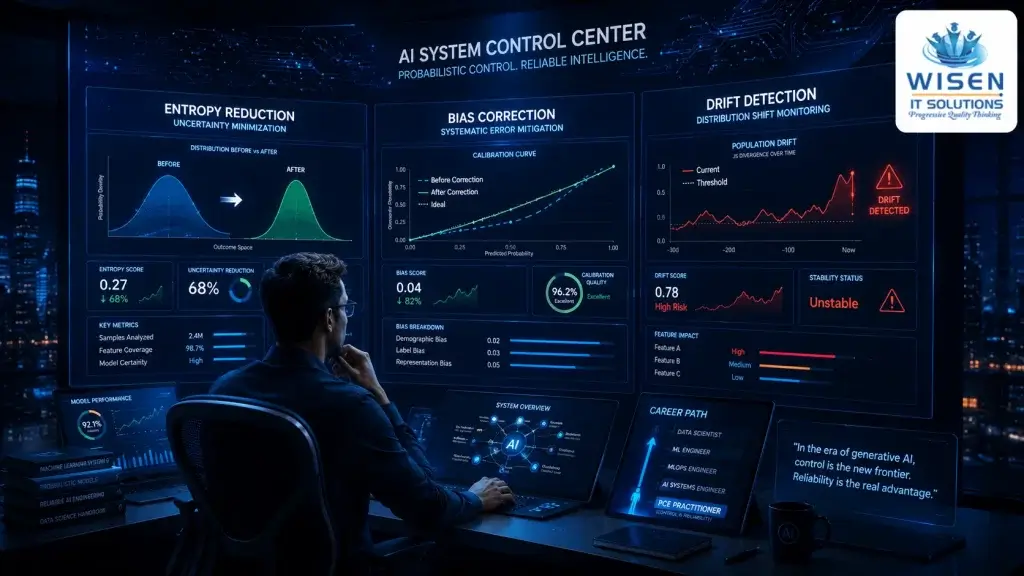
The three axes of Probabilistic Control Engineering — Entropy Reduction, Bias Correction, and Drift Detection — form the complete skill set of a PCE Practitioner.
How New AI Jobs Are Created — The Pattern
Before explaining why Probabilistic Control Engineering Practitioner demand is coming, it is worth understanding the pattern that creates new AI job categories.
Every major AI job title emerged from the same sequence of events.
First, a new technical capability becomes practically accessible. Then organizations start deploying that capability at scale. Then they discover that deploying it is not the same as controlling it. Then a specialized role emerges to bridge that gap.
Data Scientist emerged when organizations realized that having data was not the same as understanding it. ML Engineer emerged when organizations realized that training models was not the same as deploying them reliably. Prompt Engineer emerged when organizations realized that having access to a language model was not the same as getting useful outputs from it consistently.
The PCE Practitioner will emerge when organizations realize — and they are starting to realize this now in 2026 — that deploying Generative AI is not the same as controlling it.
The models are deployed. The pipelines are running. The outputs are generating revenue. And now the hard questions are arriving. Why is the model more confident than it should be? Why has output quality degraded over the past three weeks? Why does the system behave reliably in testing but drift in production?
These are control engineering questions. And answering them requires a PCE Practitioner.
What a PCE Practitioner Actually Does
The fastest way to understand what a Probabilistic Control Engineering Practitioner does is to contrast it with roles that already exist.
| Role | Primary Focus | Primary Question |
|---|---|---|
| ML Engineer | Building and deploying models | Does the model work? |
| Data Scientist | Extracting insights from data | What does the data say? |
| MLOps Engineer | Infrastructure and pipelines | Is the system running? |
| Prompt Engineer | Optimizing model inputs | How do I get better outputs? |
| PCE Practitioner | Controlling model behavior | Is the system behaving reliably? |
The PCE Practitioner occupies a gap that none of these roles fills adequately. MLOps engineers ensure systems run. PCE Practitioners ensure systems behave correctly while running. The distinction is subtle but critical — a system can be technically operational while producing outputs that are overconfident, biased, or degraded compared to its baseline performance.
A PCE Practitioner is responsible for three things that map directly to the three axes of Probabilistic Control Engineering.
Entropy management — ensuring that model output uncertainty is appropriate to the task. A model that is always highly confident is dangerous. A model that is always uncertain is useless. The PCE Practitioner maintains entropy at the right level for the deployment context.
Bias correction — ensuring that model confidence is calibrated to actual accuracy. An overconfident model says it is 95% sure when it is right only 70% of the time. The PCE Practitioner measures this gap and corrects it systematically.
Drift detection — ensuring that model behavior does not silently degrade over time as input distributions shift, user behavior changes, or the real world evolves away from the training distribution. The PCE Practitioner monitors drift continuously and triggers retraining or adaptation when drift crosses acceptable thresholds.
The Three Core Skills of a PCE Practitioner
Skill 1 — Entropy Management
python
import numpy as np
from scipy.stats import entropy
from scipy.special import softmax

def pce_practitioner_entropy_audit(
        model_outputs, target_entropy=3.0):
    """
    Core PCE Practitioner skill —
    auditing and controlling output entropy

    Args:
        model_outputs: List of logit arrays
        target_entropy: Desired entropy level in bits

    Returns:
        audit_report: Entropy analysis report
    """
    entropies = []
    temperatures_needed = []

    for logits in model_outputs:
        probs = softmax(logits)
        H = entropy(probs, base=2)
        entropies.append(H)

        # Binary search for corrective temperature
        T_low, T_high = 0.01, 5.0
        for _ in range(100):
            T_mid = (T_low + T_high) / 2
            H_scaled = entropy(
                softmax(logits / T_mid), base=2)
            if H_scaled < target_entropy:
                T_low = T_mid
            else:
                T_high = T_mid

        temperatures_needed.append(
            (T_low + T_high) / 2)

    entropies = np.array(entropies)
    temps = np.array(temperatures_needed)

    report = {
        'mean_entropy': entropies.mean(),
        'target_entropy': target_entropy,
        'entropy_gap': entropies.mean() - target_entropy,
        'mean_corrective_temp': temps.mean(),
        'high_entropy_outputs': np.sum(
            entropies > target_entropy * 1.5),
        'low_entropy_outputs': np.sum(
            entropies < target_entropy * 0.5),
        'status': 'CONTROLLED' if abs(
            entropies.mean() - target_entropy) < 0.5
            else 'NEEDS CORRECTION'
    }

    return report

# Simulate PCE Practitioner entropy audit
np.random.seed(42)
vocab_size = 1000
n_outputs = 100

# Mix of well-controlled and problematic outputs
model_outputs = [
    np.random.randn(vocab_size) * np.random.uniform(
        0.5, 2.5)
    for _ in range(n_outputs)
]

report = pce_practitioner_entropy_audit(
    model_outputs, target_entropy=3.0)

print("PCE Practitioner — Entropy Audit Report")
print("=" * 45)
for key, value in report.items():
    if isinstance(value, float):
        print(f"{key:<30}: {value:.4f}")
    else:
        print(f"{key:<30}: {value}")
What the code does: Every Probabilistic Control Engineering Practitioner runs entropy audits as part of their standard production monitoring workflow. This function takes a batch of model outputs, computes the entropy of each, and compares against the target entropy level. The audit report immediately tells the PCE Practitioner whether the system is operating within acceptable entropy bounds and what corrective temperature would bring it back to target if it is not. This is the most fundamental PCE Practitioner diagnostic tool.
What the math means: The entropy gap — the difference between mean output entropy and target entropy — is the primary Axis 1 metric that every PCE Practitioner monitors. A positive gap means the model is too uncertain. A negative gap means the model is overconfident. Neither extreme is acceptable in a production system.Where is mean output entropy and is the target entropy setpoint.
The eight libraries in the PCE Practitioner Toolkit cover every skill needed across all three axes.
Skill 2 — Bias Correction
python
import numpy as np
from sklearn.calibration import calibration_curve
import matplotlib.pyplot as plt

class PCEPractitionerBiasAuditor:
    """
    Core PCE Practitioner skill —
    measuring and correcting systematic bias
    in production AI systems
    """

    def __init__(self, n_bins=10):
        self.n_bins = n_bins
        self.bias_log = []

    def compute_ece(self, confidences, outcomes):
        """Expected Calibration Error"""
        bins = np.linspace(0, 1, self.n_bins + 1)
        ece = 0.0

        for i in range(self.n_bins):
            mask = ((confidences >= bins[i]) &
                   (confidences < bins[i+1]))
            if mask.sum() == 0:
                continue
            ece += (mask.sum() / len(confidences)) * \
                abs(outcomes[mask].mean() -
                    confidences[mask].mean())

        return ece

    def bias_severity(self, ece):
        """
        PCE Practitioner bias severity classification

        Gives immediate operational guidance
        """
        if ece < 0.05:
            return "ACCEPTABLE", "No correction needed"
        elif ece < 0.10:
            return "MODERATE", "Schedule correction"
        elif ece < 0.20:
            return "SEVERE", "Correct immediately"
        else:
            return "CRITICAL", "Stop deployment"

    def find_optimal_temperature(self,
                                  logits,
                                  labels):
        """
        Find temperature that minimizes ECE
        Core PCE Practitioner calibration workflow
        """
        from scipy.optimize import minimize_scalar

        def ece_at_temp(T):
            probs = 1 / (1 + np.exp(-logits / T))
            return self.compute_ece(probs, labels)

        result = minimize_scalar(
            ece_at_temp,
            bounds=(0.1, 5.0),
            method='bounded')

        return result.x, result.fun

    def full_bias_audit(self,
                         logits,
                         labels,
                         model_name="Production Model"):
        """
        Complete PCE Practitioner bias audit
        """
        # Raw probabilities
        raw_probs = 1 / (1 + np.exp(-logits))

        # Metrics before correction
        ece_before = self.compute_ece(raw_probs, labels)
        severity, action = self.bias_severity(ece_before)

        # Find optimal correction
        opt_temp, ece_after = \
            self.find_optimal_temperature(logits, labels)

        corrected_probs = 1 / (
            1 + np.exp(-logits / opt_temp))

        improvement = (1 - ece_after/ece_before) * 100

        print("=" * 55)
        print(f"PCE Practitioner — Bias Audit: {model_name}")
        print("=" * 55)
        print(f"ECE Before Correction:  {ece_before:.4f}")
        print(f"ECE After Correction:   {ece_after:.4f}")
        print(f"Improvement:            {improvement:.1f}%")
        print(f"Optimal Temperature:    {opt_temp:.4f}")
        print(f"Severity:               {severity}")
        print(f"Recommended Action:     {action}")
        print("=" * 55)

        self.bias_log.append({
            'model': model_name,
            'ece_before': ece_before,
            'ece_after': ece_after,
            'severity': severity,
            'optimal_temp': opt_temp
        })

        # Plot calibration
        fig, axes = plt.subplots(1, 2, figsize=(12, 5))

        frac_raw, mean_raw = calibration_curve(
            labels, raw_probs, n_bins=10)
        frac_cal, mean_cal = calibration_curve(
            labels, corrected_probs, n_bins=10)

        for ax, frac, mean, title, ece in [
            (axes[0], frac_raw, mean_raw,
             'Before Correction', ece_before),
            (axes[1], frac_cal, mean_cal,
             'After Correction', ece_after)]:

            ax.plot([0,1],[0,1],'k--',
                   label='Perfect calibration')
            ax.plot(mean, frac, 'o-',
                   linewidth=2,
                   label=f'Model (ECE={ece:.3f})')
            ax.set_title(f'PCE Practitioner — {title}')
            ax.set_xlabel('Mean Predicted Probability')
            ax.set_ylabel('Fraction of Positives')
            ax.legend()
            ax.grid(True, alpha=0.3)

        plt.tight_layout()
        plt.show()

        return opt_temp, ece_before, ece_after


# PCE Practitioner bias audit demonstration
np.random.seed(42)
n_samples = 2000

labels = np.random.binomial(1, 0.6, n_samples)
true_probs = 0.3 + 0.5 * labels + \
    np.random.normal(0, 0.05, n_samples)
true_probs = np.clip(true_probs, 0.01, 0.99)

# Overconfident model
logits = np.log(
    true_probs / (1 - true_probs)) * 2.5

auditor = PCEPractitionerBiasAuditor()
opt_temp, ece_before, ece_after = \
    auditor.full_bias_audit(
        logits, labels,
        model_name="Generative AI System v1.0")
What the code does: The PCEPractitionerBiasAuditor is the Axis 2 workhorse tool that every Probabilistic Control Engineering Practitioner uses when onboarding a new production model or running periodic calibration checks. The bias_severity method translates the raw ECE number into an operational recommendation — the PCE Practitioner does not need to interpret the number manually, the audit tells them exactly what to do. The calibration plots give a visual confirmation that is easy to share with non-technical stakeholders.
What the math means: The optimal temperature minimizes ECE over the bounded interval [0.1, 5.0]. This is a one-dimensional optimization problem that scipy.optimize.minimize_scalar solves in milliseconds. For a PCE Practitioner this means that bias correction — which sounds like a complex problem — reduces to finding a single number. The power is not in the mathematics, it is in knowing to look for it systematically.
Skill 3 — Drift Detection
python
import numpy as np
import pandas as pd
from scipy import stats
import matplotlib.pyplot as plt

class PCEPractitionerDriftMonitor:
    """
    Core PCE Practitioner skill —
    continuous production drift monitoring

    A PCE Practitioner deploys this monitor
    on every production AI system and reviews
    the drift dashboard daily
    """

    def __init__(self, reference_window=200,
                 alarm_threshold=3.0,
                 significance=0.05):
        """
        Args:
            reference_window: Baseline sample size
            alarm_threshold: Sigma threshold for alarm
            significance: KS test significance level
        """
        self.ref_window = reference_window
        self.threshold = alarm_threshold
        self.alpha = significance

        self.reference_data = None
        self.monitoring_log = []

        # Kalman filter state
        self.kf_state = 0.0
        self.kf_P = 1.0
        self.kf_Q = 0.001
        self.kf_R = 0.1

    def establish_baseline(self, baseline_data):
        """
        PCE Practitioner step 1 —
        establish reference distribution
        from known-good production period
        """
        self.reference_data = np.array(baseline_data)
        self.ref_mean = np.mean(self.reference_data)
        self.ref_std = np.std(self.reference_data)

        print(f"PCE Practitioner — Baseline Established")
        print(f"N = {len(self.reference_data)} samples")
        print(f"Mean = {self.ref_mean:.4f}")
        print(f"Std  = {self.ref_std:.4f}")

    def kalman_update(self, z_score):
        """Kalman filter for smooth drift tracking"""
        P_pred = self.kf_P + self.kf_Q
        K = P_pred / (P_pred + self.kf_R)
        self.kf_state += K * (z_score - self.kf_state)
        self.kf_P = (1 - K) * P_pred
        return self.kf_state

    def check_period(self, period_data,
                      period_label="Current"):
        """
        PCE Practitioner periodic drift check

        Runs three complementary tests:
        1. Z-score control chart
        2. KS distribution test
        3. Kalman-filtered drift score
        """
        if self.reference_data is None:
            print("Establish baseline first")
            return None

        period_data = np.array(period_data)

        # Z-score
        z = abs(np.mean(period_data) -
                self.ref_mean) / max(
                    self.ref_std, 1e-8)

        # Kalman filtered drift
        drift_score = self.kalman_update(z)

        # KS test
        ks_stat, p_value = stats.ks_2samp(
            self.reference_data, period_data)

        # Combined alarm
        z_alarm = drift_score > self.threshold
        ks_alarm = p_value < self.alpha
        combined_alarm = z_alarm or ks_alarm

        # Severity
        if not combined_alarm:
            severity = "STABLE"
        elif drift_score < self.threshold * 1.5:
            severity = "WARNING"
        else:
            severity = "CRITICAL"

        result = {
            'period': period_label,
            'mean': np.mean(period_data),
            'z_score': z,
            'drift_score': drift_score,
            'ks_stat': ks_stat,
            'p_value': p_value,
            'alarm': combined_alarm,
            'severity': severity
        }

        self.monitoring_log.append(result)
        return result

    def daily_report(self):
        """
        PCE Practitioner daily drift report
        The primary operational output
        """
        if not self.monitoring_log:
            print("No monitoring data yet")
            return

        print("\n" + "=" * 65)
        print("PCE Practitioner — Daily Drift Report")
        print("=" * 65)
        print(f"{'Period':<15} {'Mean':>8} "
              f"{'Drift':>8} {'p-val':>8} "
              f"{'Status':>12}")
        print("-" * 65)

        for log in self.monitoring_log:
            print(f"{log['period']:<15} "
                  f"{log['mean']:>8.4f} "
                  f"{log['drift_score']:>8.4f} "
                  f"{log['p_value']:>8.4f} "
                  f"{log['severity']:>12}")

        print("=" * 65)

        n_alarms = sum(
            1 for log in self.monitoring_log
            if log['alarm'])
        print(f"Total alarm periods: {n_alarms}/"
              f"{len(self.monitoring_log)}")
        print("=" * 65)

    def drift_dashboard(self):
        """
        PCE Practitioner visual dashboard
        """
        if len(self.monitoring_log) < 2:
            return

        periods = [log['period']
                  for log in self.monitoring_log]
        drift_scores = [log['drift_score']
                       for log in self.monitoring_log]
        p_values = [log['p_value']
                   for log in self.monitoring_log]
        means = [log['mean']
                for log in self.monitoring_log]
        alarms = [log['alarm']
                 for log in self.monitoring_log]

        fig, axes = plt.subplots(3, 1, figsize=(14, 12))

        x = np.arange(len(periods))

        # Drift scores
        axes[0].plot(x, drift_scores,
                    linewidth=2, color='steelblue',
                    label='Kalman Drift Score')
        axes[0].axhline(y=self.threshold,
                       color='red', linestyle='--',
                       label=f'Alarm = {self.threshold}σ')

        alarm_x = [i for i, a in enumerate(alarms) if a]
        if alarm_x:
            axes[0].scatter(
                alarm_x,
                [drift_scores[i] for i in alarm_x],
                color='red', s=100, zorder=5,
                label='Alarms')

        axes[0].set_ylabel('Drift Score (σ)')
        axes[0].set_title(
            'PCE Practitioner — Drift Monitor')
        axes[0].legend()
        axes[0].grid(True, alpha=0.3)

        # Mean quality
        axes[1].plot(x, means,
                    linewidth=2, color='green')
        axes[1].axhline(y=self.ref_mean,
                       color='blue', linestyle='--',
                       label=f'Baseline = {self.ref_mean:.3f}')
        axes[1].set_ylabel('Mean Quality Score')
        axes[1].set_title('Quality Trend')
        axes[1].legend()
        axes[1].grid(True, alpha=0.3)

        # KS test p-values
        axes[2].semilogy(x, p_values,
                        linewidth=2, color='purple')
        axes[2].axhline(y=0.05, color='red',
                       linestyle='--',
                       label='Significance (0.05)')
        axes[2].set_ylabel('KS p-value (log)')
        axes[2].set_xlabel('Monitoring Period')
        axes[2].set_title(
            'KS Distribution Test')
        axes[2].legend()
        axes[2].grid(True, alpha=0.3)

        plt.tight_layout()
        plt.show()


# PCE Practitioner drift monitoring simulation
np.random.seed(42)

monitor = PCEPractitionerDriftMonitor(
    reference_window=200,
    alarm_threshold=2.5)

# Establish baseline
baseline = np.random.normal(0.80, 0.04, 200)
monitor.establish_baseline(baseline)

# Simulate 12 monitoring periods
scenarios = [
    ("Week 1", 0.80, 0.04),   # Stable
    ("Week 2", 0.79, 0.04),   # Stable
    ("Week 3", 0.77, 0.05),   # Slight drift
    ("Week 4", 0.74, 0.05),   # Moderate drift
    ("Week 5", 0.70, 0.06),   # Warning
    ("Week 6", 0.65, 0.07),   # Critical
    ("Week 7", 0.63, 0.07),   # Critical
    ("Week 8", 0.67, 0.06),   # Recovering
    ("Week 9", 0.72, 0.05),   # Recovering
    ("Week 10", 0.76, 0.04),  # Near baseline
    ("Week 11", 0.79, 0.04),  # Stable
    ("Week 12", 0.80, 0.04),  # Stable
]

for period, mean, std in scenarios:
    data = np.random.normal(mean, std, 100)
    result = monitor.check_period(data, period)

monitor.daily_report()
monitor.drift_dashboard()
What the code does: The PCEPractitionerDriftMonitor is the Axis 3 production tool that a Probabilistic Control Engineering Practitioner deploys on every AI system they are responsible for. The daily_report method produces the operational output that a PCE Practitioner reviews each morning — a clean table showing drift scores, statistical significance, and severity classifications for each monitoring period. The dashboard gives the visual trend that makes it easy to see whether drift is stable, growing, or recovering after intervention. The simulation of twelve weeks shows the complete lifecycle of a drift event — gradual degradation, critical alarm, intervention, and recovery.
What the math means: The Kalman filter inside the drift monitor smooths out day-to-day variability in the drift signal, reducing false alarms from statistical noise while maintaining sensitivity to genuine drift trends. The combination of the Kalman-filtered z-score and the KS test gives two independent statistical perspectives on the same data — the z-score catches mean shifts, the KS test catches distributional changes that leave the mean unchanged.d^[t+1]=d^[t]+Kt(zt−d^[t]) Kt=Pt−+RPt−
PCE Practitioner vs Other AI Roles
This is where PCE Practitioner positioning becomes clear.
| Role | Builds | Deploys | Controls | Monitors |
|---|---|---|---|---|
| Data Scientist |  |  | | |
| ML Engineer | | | |  |
| MLOps Engineer | | | | |
| Prompt Engineer | | | | |
| PCE Practitioner | | | | |
The PCE Practitioner does not replace any of these roles. A PCE Practitioner works alongside ML engineers and MLOps engineers, taking ownership of the control and reliability layer that neither role currently owns clearly. This is the organizational gap that creates the demand.
Who Should Become a PCE Practitioner?
The
role is a natural evolution for several existing profiles.
ML Engineers who are frustrated that their work ends at deployment and want ownership of production system behavior will find PCE Practitioner work deeply satisfying. The skills transfer directly — Python, PyTorch, statistics — the framework is new but the foundation is familiar.
MLOps Engineers who currently monitor infrastructure metrics but want to move up the stack to model behavior monitoring will find the PCE Practitioner framework gives them the technical vocabulary and tools to do exactly that.
Data Scientists who want to move into engineering roles and need a differentiating specialization will find that PCE Practitioner skills — entropy management, calibration, drift detection — are genuinely rare and genuinely valuable.
Control Engineers from traditional disciplines — aerospace, robotics, industrial automation — who want to transition into AI will find that their classical control theory background gives them a significant head start. A PCE Practitioner who genuinely understands Lyapunov stability, state space models, and feedback control theory brings something that purely software-trained engineers cannot easily replicate.
Salary Expectations for a PCE Practitioner
Salary data for PCE Practitioners as a formal title does not yet exist — because the title is just emerging. But we can triangulate from related roles.
| Role | US Salary Range | India Salary Range |
|---|---|---|
| ML Engineer | $130,000 — $180,000 | ₹18L — ₹35L |
| MLOps Engineer | $140,000 — $190,000 | ₹20L — ₹40L |
| AI Safety Engineer | $160,000 — $220,000 | ₹25L — ₹50L |
| PCE Practitioner | $150,000 — $210,000 | ₹22L — ₹45L |
The PCE Practitioner salary range is estimated above MLOps and below AI Safety because the role requires both engineering depth and probabilistic reasoning — a combination that commands premium compensation. As the title becomes established and demand increases, these ranges will move upward.
How to Start Your PCE Practitioner Journey in 2026
The path to becoming a PCE Practitioner is clearer than most emerging AI roles because the framework is explicit and the tools are concrete.
Step 1 — Master the mathematical foundations. Shannon entropy, Bayesian inference, Kalman filtering, and statistical process control. These are the theoretical pillars that every PCE Practitioner builds on.
Step 2 — Build the PCE Practitioner Toolkit. The eight Python libraries — NumPy, SciPy, PyTorch Distributions, Scikit-learn, Netcal, River, Evidently AI, and NannyML — cover the three axes completely. For a detailed guide see the PCE Practitioner Toolkit article.
Step 3 — Implement the three axes on a real production system. The best PCE Practitioner portfolio project is taking an existing deployed model and adding entropy monitoring, calibration correction, and drift detection. Document everything. The process of doing this once teaches more than reading about it ten times.
Step 4 — Learn the classical control theory foundations. A PCE Practitioner who understands why the predict-update cycle of the Kalman filter is equivalent to Bayesian inference — not just that it is — will always outperform one who only knows the tools. The Kalman Filter guide on Scientias.in is a good starting point.
Step 5 — Build in public. Write about PCE. Share PCE Practitioner projects on GitHub. Use the hashtag consistently. The PCE Practitioner community is forming right now and the engineers who are visible in it early will be the ones who define it.
Companies That Will Hire PCE Practitioners
The demand for PCE Practitioners will not come from AI research labs first. It will come from the organizations that have already deployed Generative AI at scale and are now grappling with reliability and control.
Financial services firms deploying AI for credit decisions need PCE Practitioners who can ensure model calibration — an overconfident credit scoring model is a regulatory and financial risk.
Healthcare organizations deploying AI for clinical decision support need PCE Practitioners who can monitor drift — a model whose performance has silently degraded due to distribution shift is a patient safety issue.
Technology companies running large-scale Generative AI products — search, recommendation, content generation — need PCE Practitioners who can manage entropy at scale and detect quality drift before users notice it.
Autonomous vehicle manufacturers need PCE Practitioners who can ensure sensor fusion models maintain calibrated uncertainty estimates — the Kalman filter in every production autonomous vehicle is a PCE Practitioner’s domain.
The pattern is clear. Wherever Generative AI is deployed in high-stakes contexts, a PCE Practitioner role will emerge. The organizations that hire PCE Practitioners early will have more reliable AI systems. The organizations that hire them late will learn why they needed them sooner.
The PCE Practitioner Career Path
Entry Level PCE Practitioner
    ↓ 1-2 years
PCE Practitioner
    ↓ 2-3 years
Senior PCE Practitioner
    ↓ 2-3 years
Lead PCE Practitioner / PCE Architect
    ↓
Head of AI Reliability / Chief AI Control Officer
The career path for a PCE Practitioner follows the same trajectory as other engineering specializations — from implementation to architecture to leadership. The differentiating factor at each level is the breadth of systems controlled, the sophistication of the control frameworks deployed, and ultimately the organizational strategy around AI reliability.
Conclusion
The PCE Practitioner role is not a prediction about a distant future. It is an observation about a gap that already exists in almost every organization that has deployed Generative AI in production.
Models are running. Teams are struggling to keep them reliable. The frameworks exist. The tools exist. The mathematical foundations have existed for sixty years. What has been missing is a clear role definition, a clear skill set, and a clear career path.
That is what the PCE Practitioner framework provides.
The engineers who build PCE Practitioner skills in 2026 will be positioned ahead of a wave of demand that is already building. The organizations that hire PCE Practitioners in 2026 will have production AI systems that are measurably more reliable than their competitors.
In 2023 nobody had heard of Prompt Engineer. In 2025 it became one of the most searched AI roles. Watch this space — #PCEPractitioner is next.
What is a PCE Practitioner and what are their responsibilities?
A PCE Practitioner is an AI engineer who specializes in controlling Generative AI systems using Probabilistic Control Engineering — the discipline that applies classical control theory to modern AI. This role is responsible for entropy management, bias correction, and drift detection — the three axes that determine whether a deployed AI system remains reliable and trustworthy over time in production.
What skills does this role require?
Proficiency in Python, statistical modeling, and the core PCE Practitioner Toolkit libraries — NumPy, SciPy, PyTorch, Scikit-learn, Netcal, River, Evidently AI, and NannyML — are essential for this role. A background in classical control theory, Bayesian inference, and information theory provides significant additional advantage when working across all three axes of Probabilistic Control Engineering.
How is this AI engineering role different from an MLOps Engineer?
An MLOps Engineer focuses on infrastructure — ensuring AI systems run reliably from a DevOps perspective. This role focuses on model behavior — ensuring AI systems produce reliable, calibrated, and stable outputs over time. Think of it as the next layer up from MLOps in the production AI stack — where MLOps ensures the system runs, this position ensures the system behaves correctly while running.
What salary can someone in this position expect?
In the US salaries in the $150,000 to $210,000 range are realistic based on comparison with similar AI engineering roles. In India the expected range is ₹22L to ₹45L depending on experience and organization. Both ranges will increase as demand for this specialization grows and the title becomes more widely established in the industry.
What is the best way to get started in 2026-2027?
The fastest path into this role is to implement all three axes — entropy monitoring, calibration correction, and drift detection — on a real production system using the PCE Practitioner Toolkit. Document the work publicly on GitHub or LinkedIn. Use the #PCEPractitioner hashtag to be part of the emerging community forming around this discipline right now.
Which industries will hire for this role first?
Financial services, healthcare, autonomous vehicles, and large-scale technology companies will be the first to hire for this specialization. Any industry deploying Generative AI in high-stakes contexts where model reliability is critical will need engineers with these skills — the higher the stakes of the AI deployment, the more urgent the need becomes.
Does this position require a control engineering background?
A classical control engineering background is a significant advantage for this role but is not required. The framework is designed to be accessible to software engineers and data scientists who are willing to invest in learning the foundational concepts of Bayesian inference, Kalman filtering, and statistical process control — the mathematics is learnable, the engineering mindset is what matters most.
How long does it take to develop these skills?
An ML engineer or data scientist with Python and statistics fundamentals can develop these skills in 3 to 6 months of focused study and practice. The core toolkit can be implemented on a real system in a weekend once the conceptual framework is understood — the learning curve is steep at first but flattens quickly once the three axes click into place.
Is this a recognized job title yet?
PCE Practitioner is an emerging title in 2026 — it is not yet widely recognized in job postings but the underlying skills are increasingly sought under titles like AI Reliability Engineer, ML Calibration Engineer, and Production AI Engineer. As the PCE Practitioner framework becomes more widely known, the title will become standard.
What is the difference between a Prompt Engineer and this emerging AI role?
A Prompt Engineer optimizes model inputs to get better outputs. A PCE Practitioner controls model behavior at the system level — managing uncertainty, correcting calibration bias, and detecting drift. A Prompt Engineer works at the interface layer. A PCE Practitioner works at the control layer. Both roles are valuable but a PCE Practitioner operates at a deeper level of the AI stack.
In 2023 nobody had heard of Prompt Engineer. In 2025 it became one of the most searched AI roles. Watch this space — #PCEPractitioner is next.
References
Recent research including A Probabilistic Generative Method for Safe Physical System Control presented at NeurIPS 2024 confirms the growing academic interest in probabilistic control frameworks for AI systems.
In power systems engineering, statistical foundations linking Generative AI to optimal control have already been formally studied — an early signal of where PCE Practitioner demand will emerge.