
Table of Contents
Probabilistic Control Engineering for Generative AI
Generative AI systems are powerful. But power without control is a liability. Large language models hallucinate. Diffusion models drift. Reinforcement learning agents exploit reward functions in ways nobody anticipated. The engineering discipline built to address these problems is Probabilistic Control Engineering for Generative AI — and it is one of the most consequential emerging fields in applied AI engineering today.
This page is the central research hub for PCE on Scientias AI Labs, published by Wisen IT Solutions, Chennai, India. Everything here — the theory, the frameworks, the Python implementations, the career guides — is written for practising AI engineers who want to build Generative AI systems that hold up in production.
What is Probabilistic Control Engineering for Generative AI?
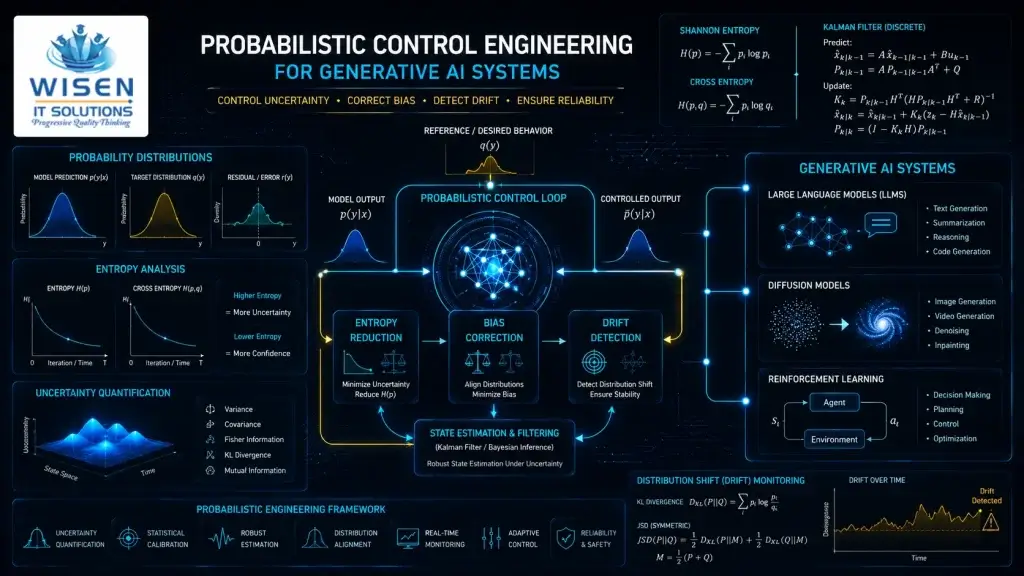
Probabilistic Control Engineering for Generative AI is a discipline that applies probability theory, stochastic control systems, and classical engineering feedback principles to the problem of making Generative AI systems reliable and controllable under real-world conditions.
The starting point is straightforward. Generative AI models are not deterministic. A language model does not produce one fixed answer — it samples from a probability distribution over possible outputs. A diffusion model generates images by reversing a stochastic noising process. A reinforcement learning agent learns by exploring a probabilistic environment. These systems are uncertain by design.
What PCE asks is: given that uncertainty is unavoidable, how do we engineer systems that behave reliably anyway? How do we measure that uncertainty, bound it, and build control mechanisms that keep the system inside acceptable operating limits?
This is fundamentally different from traditional AI engineering, which mostly focuses on improving model accuracy. PCE focuses on what happens after accuracy — on stability, calibration, drift, and control. It brings the rigour of classical control theory into the probabilistic world of modern Generative AI.
The mathematical foundation of PCE sits on three key ideas.
Shannon Entropy measures the uncertainty in model outputs:
H(X) = −Σ P(x) · log₂ P(x)
The Bayesian Update Rule describes how beliefs should be revised as new evidence arrives:
P(θ | D) ∝ P(D | θ) × P(θ)
The Kalman Filter State Estimate tracks system state under noisy measurements:
x̂ₖ = A · x̂ₖ₋₁ + K · (zₖ − H · A · x̂ₖ₋₁)
These are not academic exercises. They are working tools that PCE practitioners use daily to reason about how Generative AI systems behave and how to keep them within acceptable bounds.
The Three Axes of Probabilistic Control Engineering for Generative AI
Every PCE framework for Generative AI is organised around three engineering axes. These map directly to problems that AI engineering teams face when deploying models into production.
Axis 1 — Entropy Reduction
Entropy reduction is about controlling the spread of a model’s output distribution. A high-entropy language model produces highly variable and often unreliable outputs. A well-engineered PCE system monitors output entropy and adjusts model parameters — temperature, top-p sampling, beam width — dynamically based on task requirements. The goal is not to make the model deterministic, but to keep its uncertainty within bounds that make its outputs consistently usable.
Axis 2 — Bias Correction
Bias correction addresses systematic errors — the cases where a model is not just uncertain but consistently wrong in a predictable direction. In PCE, bias correction involves building calibration systems that measure whether a model’s stated confidence matches its actual accuracy, and feedback loops that correct the discrepancy when it does not. A well-calibrated model that states it is 80% confident should be correct approximately 80% of the time.
Axis 3 — Drift Detection
Distribution drift occurs when the real-world data a model encounters in production differs from the data it was trained on. It is one of the most common and most dangerous failure modes in deployed AI systems. PCE drift detection systems continuously monitor the statistical properties of model inputs and outputs, flagging when the system operates outside the distribution it was designed for — before that becomes a visible production failure.
Engineering Foundations of Probabilistic Control Engineering for Generative AI
PCE has deep roots in classical control theory — the engineering discipline that gave us PID controllers, feedback loops, and stability analysis long before neural networks existed. Understanding these roots is essential to applying PCE well.
Classical control theory was built for deterministic systems. You know your inputs, you model your system dynamics, and you design a controller that keeps outputs within acceptable bounds. The mathematics is well understood and has been proven in aerospace, manufacturing, and robotics for decades.
Generative AI breaks every assumption that classical control theory was built on. Inputs are natural language or images — high-dimensional and ambiguous. System dynamics are learned from data and not fully understood even by the engineers who trained the model. Outputs are distributions, not fixed values.
PCE extends classical control engineering into this probabilistic world. The feedback loop remains — but instead of measuring a fixed output and comparing it to a target, you measure a probability distribution and compare its properties to acceptable bounds. The controller acts not on a single value but on the parameters of a distribution.
The Kalman Filter is one of the most direct bridges between classical control theory and modern AI engineering. Originally developed for NASA’s Apollo program in 1960, it provides a mathematically principled way to maintain a reliable estimate of system state when measurements are noisy — exactly the problem PCE practitioners face when monitoring Generative AI systems in production.
Probabilistic Control Engineering in AI Cybersecurity
The principles of PCE extend naturally into AI cybersecurity. Physical layer security — protecting wireless AI communication systems against eavesdropping and signal interference — relies on stochastic geometry, Rayleigh fading channel models, and Kalman filtering. These are PCE tools applied directly to a security engineering problem.
The secrecy capacity of a communication channel under the PCE framework is expressed as:
Cs = max[log(1 + SNRmain) − log(1 + SNReavesdrop), 0]
This formulation treats communication security as a probabilistic control problem — which is exactly how modern AI cybersecurity engineers are beginning to approach it.
Who is a Probabilistic Control Engineering for Generative AI Practitioner?
A PCE Practitioner is an AI engineer who specialises in applying Probabilistic Control Engineering for Generative AI to production systems. The role sits at the intersection of three disciplines that rarely overlap in a single engineer: probability theory, control systems engineering, and Generative AI.
In practice, a PCE Practitioner designs uncertainty-aware AI pipelines, implements entropy reduction and bias correction systems, builds drift detection and model monitoring infrastructure, and applies Bayesian inference and Kalman filtering to real AI control problems. They are the engineers who make Generative AI systems trustworthy enough to deploy where reliability is non-negotiable.
Most AI teams have plenty of engineers who can train models. Very few have engineers who understand how to control those models once they are running in production. That gap is where the PCE Practitioner operates — and it is why demand for this skillset is growing faster than supply.
Probabilistic Control Engineering for Generative AI — Research and Articles
Foundations
How PCE Borrows from Classical Control Theory
Kalman Filter Explained: From Classical Control Theory to Modern AI Engineering
The Three Axes of PCE for Generative AI: Entropy Reduction, Bias Correction, and Drift Detection
Applications
Probabilistic Models for Physical Layer Security: A Complete Guide for AI Cybersecurity Engineers
PCE Practitioner
PCE Practitioner: A Complete Guide to Probabilistic Control Engineering for Generative AI (2026)
PCE Practitioner Toolkit: The Proven Python Libraries Every AI Engineer Needs in 2026
Why PCE Practitioner Will Be the Most In-Demand AI Job of 2026–2027
Probabilistic Control Engineering for Generative AI Practitioner Community
The PCE Practitioner community is active and growing. If you are working with probabilistic control systems for Generative AI, or want to connect with engineers who are, these are the right places to start:
r/PCEPractitioner on Reddit — technical discussions, Python implementations, and career questions LinkedIn PCE Practitioners Group — professional network for engineers and researchers working in this space
Probabilistic Control Engineering for Generative AI — Frequently Asked Questions
What does PCE stand for in AI engineering?
PCE stands for Probabilistic Control Engineering. In the context of Generative AI, it refers to applying probability theory and control systems principles to design AI systems that behave reliably under uncertainty.
How is PCE different from traditional machine learning?
Traditional machine learning focuses on building models that make accurate predictions. PCE focuses on what happens after accuracy — measuring and controlling the uncertainty in those predictions, detecting drift, correcting bias, and keeping AI systems stable in production over time.
Do I need a PhD to become a PCE Practitioner?
No. A strong foundation in probability theory, statistics, and Python is more important than academic credentials. Many working PCE practitioners come from software engineering or applied mathematics backgrounds and built their skills through focused study and hands-on project work.
What Python libraries do PCE Practitioners use?
The core stack includes PyMC and NumPyro for probabilistic programming, NumPy and SciPy for mathematical computing, and Scikit-learn for model calibration. For drift detection, libraries like Alibi Detect and River are widely used.
Is Kalman Filtering still relevant in modern Generative AI?
Yes. While the Kalman Filter was developed in the 1960s for aerospace applications, its core idea — maintaining a probabilistic estimate of system state under noisy measurements — applies directly to AI systems that process sequential data, sensor inputs, or time-series information.
What industries hire PCE Practitioners?
Healthcare AI, autonomous vehicles, financial services, robotics, defence, and legal technology are the primary industries. Any domain where Generative AI is deployed in high-stakes environments and where reliability and auditability are non-negotiable needs PCE skills.
How is entropy used in Probabilistic Control Engineering for Generative AI?
Shannon entropy measures the uncertainty in a probability distribution. In language models, output entropy is directly influenced by the temperature parameter. PCE practitioners monitor and adjust output entropy dynamically to keep model outputs within reliable operating bounds for specific task types.
What is distribution drift and why does it matter?
Distribution drift occurs when the statistical properties of data a model encounters in production differ from its training data. It causes model performance to degrade gradually and often silently. PCE drift detection systems catch this early — before it becomes a visible failure.
How long does it take to become a Probabilistic Control Engineering Practitioner?
With a solid engineering or mathematics background, most engineers develop practical PCE skills within 12 to 18 months of focused study. The critical path runs through Bayesian inference, probabilistic programming, and hands-on work with Generative AI systems.
Where can I follow Probabilistic Control Engineering for Generative AI research published by Wisen IT Solutions?
All PCE research on Scientias is published under two dedicated categories: PCE for Generative AI covering theory and frameworks, and PCE for AI Practitioner covering career guides, toolkits, and practical resources. Both categories are accessible from the main navigation menu.
About This Probabilistic Control Engineering for Generative AI Resource Hub
All Probabilistic Control Engineering for Generative AI research and practitioner content on Scientias is developed and published by Wisen IT Solutions, Chennai, India. Scientias AI Labs is the AI engineering research platform of Wisen IT Solutions — dedicated to advancing rigorous, practical, and original research in AI engineering.