
- What Is RAG?
- Why RAG Became So Popular
- What Is TAG?
- The Core Difference Between RAG and TAG
- Quick Comparison Table
- How RAG Actually Works
- Where RAG Works Extremely Well
- How TAG Works
- Where TAG Becomes Powerful
- Why TAG Feels Like the Future
- Can RAG and TAG Work Together?
- Why AI Agents Need More Than Just RAG
- Real-World Examples
- The Rise of AI Agents
- So Which One Is Better?
- The Bigger Shift Happening Right Now
- Final Verdict
AI systems are evolving much faster than most people expected.
A couple of years ago, the biggest challenge was simply getting large language models to generate useful text consistently. Today, the conversation has shifted toward something much bigger:
How do we make AI systems actually useful in the real world?
That’s where concepts like RAG and TAG come into the picture.
If you’ve been exploring AI agents, Claude Code, ChatGPT Codex, MCP servers, or autonomous workflows lately, you’ve probably seen these terms appearing more frequently.
At first glance, they sound similar.
But they solve very different problems.
And understanding that difference is becoming increasingly important for developers building modern AI systems in 2026.
What Is RAG?
RAG stands for:
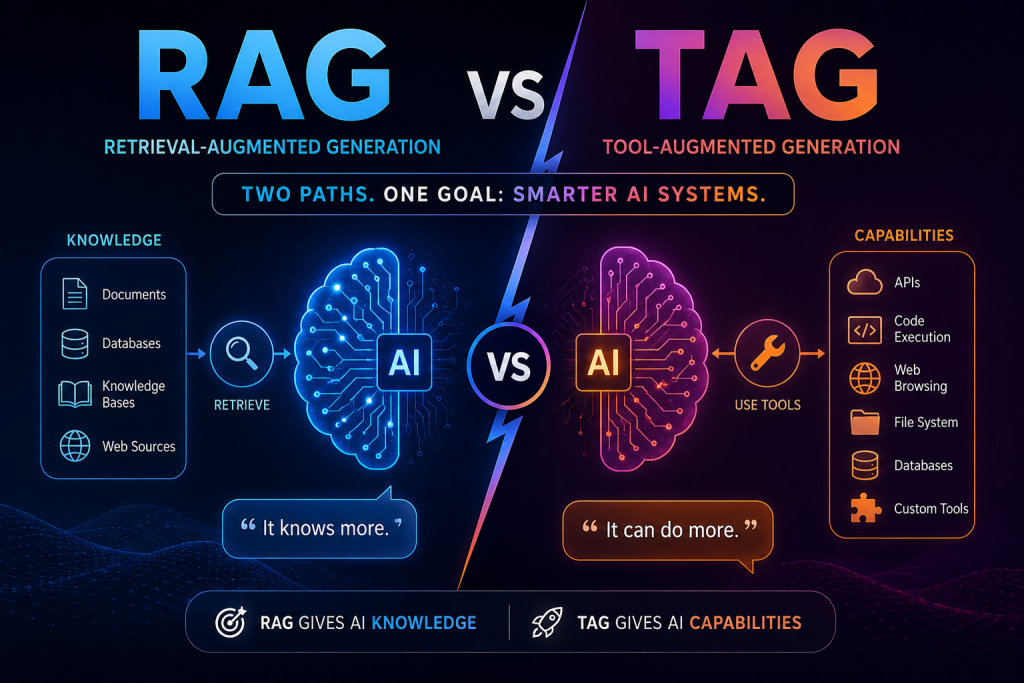
Retrieval-Augmented GenerationThe idea behind RAG is fairly straightforward:
instead of forcing an AI model to rely only on what it learned during training, you allow it to retrieve external information before generating a response.
Think of it like giving the AI:
- access to documents
- company knowledge bases
- PDFs
- databases
- internal wikis
- research papers
before it answers a question.
Why RAG Became So Popular
Traditional LLMs have a major limitation:
their knowledge becomes outdated quickly.For example:
- GPT may not know your private company documents
- Claude may not know your latest research paper
- an AI chatbot may not know your internal policies
RAG solves this by retrieving relevant information dynamically.
The workflow usually looks like this:
- User asks a question
- System searches a vector database
- Relevant chunks are retrieved
- Those chunks are added to the prompt
- The LLM generates a grounded response
This dramatically improves:
- factual accuracy
- domain specificity
- enterprise usefulness
What Is TAG?
TAG stands for:
Tool-Augmented GenerationThis is where things get much more interesting.
Instead of simply retrieving information, TAG allows AI systems to:
use tools and perform actions.
That means the AI can:
- call APIs
- browse websites
- access databases
- execute code
- use calculators
- read files
- interact with external systems
In simple terms:
RAG gives AI knowledge.
TAG gives AI capabilities.
That distinction is huge.
Modern AI agents rely heavily on tool calling workflows. You can explore the official OpenAI Tool Calling Documentation to understand how LLMs interact with external systems, APIs, and executable tools.
The Core Difference Between RAG and TAG
RAG focuses on:
information retrievalTAG focuses on:
tool usage and action executionOne helps AI know things.
The other helps AI do things.
If you’re exploring modern AI coding workflows, check out our detailed comparison of Claude Code vs ChatGPT Codex to understand how today’s AI coding agents combine reasoning, repository awareness, and autonomous tool usage.
Quick Comparison Table
| Feature | RAG | TAG |
|---|---|---|
| Full Form | Retrieval-Augmented Generation | Tool-Augmented Generation |
| Main Goal | Retrieve knowledge | Execute actions |
| Uses | Vector databases | Tools/APIs |
| Best For | Knowledge grounding | AI agents |
| Can Perform Actions? | No | Yes |
| Common Example | PDF chatbot | AI coding agent |
| External Access | Documents/data | APIs/tools/systems |
| Popular In | Enterprise search | Autonomous AI workflows |
| Improves | Accuracy | Capability |
How RAG Actually Works
A typical RAG system contains:
- embeddings model
- vector database
- retriever
- LLM
When documents are added:
- text gets converted into embeddings
- embeddings are stored in a vector database
When a user asks something:
- the query becomes an embedding
- similar chunks are retrieved
- the LLM receives those chunks as context
This is why RAG is heavily used in:
- enterprise AI chatbots
- customer support systems
- document Q&A systems
- research assistants
Where RAG Works Extremely Well
RAG shines when:
- information changes frequently
- knowledge is private
- factual grounding matters
Excellent examples include:
- legal document assistants
- medical knowledge systems
- internal company chatbots
- academic research tools
Instead of retraining an entire model every week, you simply update the database.
That’s incredibly efficient.
How TAG Works
TAG systems operate differently.
Instead of retrieving text context, the AI gets access to tools.
For example:
Tool: Weather API
Tool: File System
Tool: Python Executor
Tool: Browser
Tool: Database Query Engine
The AI decides:
- when to use a tool
- which tool to call
- what parameters to send
- how to interpret results
This is what powers modern AI agents.
Where TAG Becomes Powerful
TAG is what enables:
- autonomous coding agents
- browser agents
- workflow automation
- AI research assistants
- system orchestration
For example:
- Claude Code editing repositories
- ChatGPT running Python
- agents browsing the web
- AI systems querying APIs
These are all TAG-style behaviors.
Why TAG Feels Like the Future
RAG made AI systems more informed.
TAG makes them more capable.
That’s a major shift.
A RAG chatbot can tell you:
“Here’s how deployment works.”
A TAG-enabled agent can:
actually deploy the application.
That changes everything.
Can RAG and TAG Work Together?
Absolutely.
And honestly:
most advanced AI systems already combine both.This is where modern AI architecture is heading.
Example:
Claude Code
May use:
- RAG → repository understanding
- TAG → terminal commands and file editing
Enterprise AI Assistant
May use:
- RAG → internal documentation retrieval
- TAG → ticket creation and workflow automation
Why AI Agents Need More Than Just RAG
For a while, many people believed RAG alone was enough to create powerful AI systems.
But eventually developers realized something important:
knowledge alone does not create autonomous behavior.An AI may know:
- how to query a database
- how to deploy software
- how to fix code
But without tools:
- it cannot actually perform those tasks.
That’s exactly why TAG is becoming central to agentic AI.
Real-World Examples
| System | Uses RAG? | Uses TAG? |
|---|---|---|
| PDF Chatbot | Yes | No |
| Enterprise Knowledge Assistant | Yes | Yes |
| Claude Code | Yes | Yes |
| Browser Agent | No | Yes |
| Research AI Agent | Yes | Yes |
| Simple LLM Chat | No | No |
The Rise of AI Agents
The growing popularity of:
- Claude Code
- ChatGPT Codex
- MCP servers
- autonomous workflows
- multi-agent systems
is pushing TAG into the spotlight.
Modern AI systems are no longer passive chat interfaces.
They’re becoming:
- operational systems
- workflow engines
- autonomous assistants
And that requires tools.
So Which One Is Better?
The truth is:
RAG and TAG are complementary technologies.
You usually don’t choose one instead of the other.
You combine them.
Use RAG when:
- knowledge grounding matters
- documents are important
- hallucination reduction matters
Use TAG when:
- actions matter
- automation matters
- workflows matter
- execution matters
The strongest AI systems in 2026 use both together.
The Bigger Shift Happening Right Now
The real story isn’t just RAG vs TAG.
It’s the broader transformation of AI systems from:
text generatorsinto:
autonomous software agents.That shift is changing:
- software engineering
- enterprise automation
- developer tooling
- productivity workflows
- how humans interact with computers
And we’re still only in the early stages.
The growing influence of AI coding systems is also reshaping how developers learn software engineering. Our detailed article on AI-Assisted Programming Learning vs Traditional Programming Learning explores how modern AI tools are transforming developer education and programming workflows.
Final Verdict
RAG gave AI systems access to knowledge.
TAG gives AI systems the ability to interact with the world.
One improves understanding.
The other enables action.
And together, they’re forming the foundation of modern AI agents.
What is RAG in AI?
RAG stands for Retrieval-Augmented Generation. It allows AI systems to retrieve external information before generating responses.
What is TAG in AI?
TAG stands for Tool-Augmented Generation. It enables AI systems to use tools, APIs, browsers, and external systems to perform actions.
Is TAG replacing RAG?
No. TAG and RAG solve different problems and are often used together in advanced AI systems.
Which is better for AI agents?
Most modern AI agents benefit from both RAG and TAG. RAG provides contextual knowledge, while TAG enables operational capabilities.
Does Claude Code use RAG or TAG?
Systems like Claude Code likely combine both approaches for repository understanding, reasoning, and tool execution workflows.
Why is TAG becoming important in 2026?
Because modern AI systems are evolving beyond chatbots into autonomous agents capable of interacting with tools and real-world systems.