
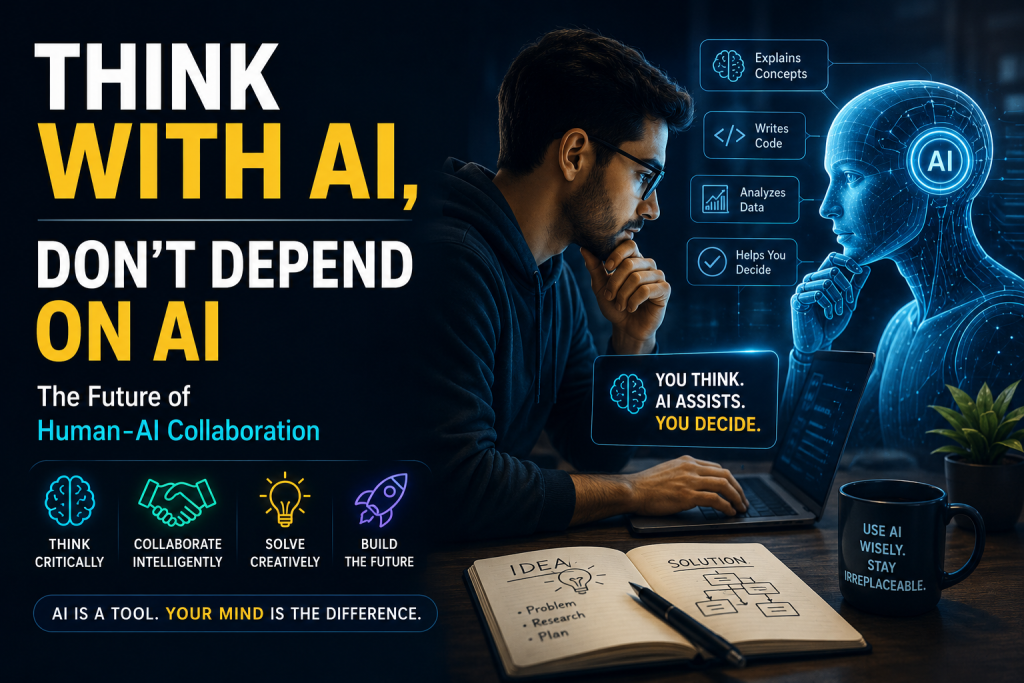
- Why AI Feels So Powerful Right Now
- The Problem Starts When Thinking Stops
- Fast Answers Are Not the Same as Deep Understanding
- The Best Developers Still Think Independently
- AI Should Expand Thinking, Not Replace It
- A Good AI Workflow Looks Like This
- Why Beginners Need to Be Careful
- AI Is Best When It Explains, Not Just Generates
- The Real Future Is Human + AI Collaboration
- Why Critical Thinking Matters More Than Ever
- AI Dependency Is Already Becoming Visible
- The Goal Isn’t To Avoid AI
- Think First. Then Use AI.
- The Future of Software Engineering
- Final Thoughts
AI tools are becoming so powerful that sometimes it feels like we’re only one step away from fully automated thinking.
You type a prompt.
The AI writes the code.
It explains the bug.
It drafts the architecture.
It even generates documentation and test cases.
For developers, students, designers, and creators, this feels almost magical.
But somewhere inside all this excitement, an important question is starting to emerge:
Are we using AI to improve our thinking — or to avoid thinking entirely?
That distinction matters more than most people realize.
Because the future probably doesn’t belong to humans alone.
And it probably doesn’t belong to AI alone either.
It belongs to people who learn how to think with AI without becoming dependent on it.
Why AI Feels So Powerful Right Now
The current generation of AI systems is genuinely impressive.
Modern tools like:
can dramatically accelerate work that used to take hours.
You can:
- generate working applications
- debug code faster
- summarize research papers
- automate repetitive tasks
- understand unfamiliar concepts quickly
- build prototypes in minutes
For many people, AI already feels less like a tool and more like an intelligent collaborator.
And honestly, that shift is real.
AI is changing how humans interact with computers.
The Problem Starts When Thinking Stops
AI becomes dangerous when it quietly replaces your reasoning process instead of supporting it.
This happens more often than people admit.
For example:
- copying AI-generated code without understanding it
- accepting answers without verification
- relying on AI for every decision
- skipping foundational learning
- losing patience for problem-solving
At first, it feels efficient.
But over time, something subtle happens:
your ability to think independently starts weakening.And that’s a serious long-term problem.
Fast Answers Are Not the Same as Deep Understanding
One of AI’s biggest strengths is speed.
But speed can create an illusion of mastery.
A developer can generate:
- APIs
- authentication systems
- database queries
- frontend components
within minutes.
But if the AI-generated code suddenly breaks in production, the real question becomes:
Do you actually understand what’s happening underneath?
That’s where the difference between:
- assistance
and - dependency
becomes painfully obvious.
The Best Developers Still Think Independently
Strong engineers don’t just accept outputs.
They:
- question assumptions
- validate logic
- analyze tradeoffs
- understand architecture
- debug deeply
- think systematically
AI can accelerate these processes.
But it cannot replace the mindset behind them.
The developers who will thrive in the AI era are not the ones who blindly automate everything.
They’re the ones who combine:
- human judgment
- technical understanding
- critical thinking
- AI acceleration
into a single workflow.
AI Should Expand Thinking, Not Replace It
The healthiest way to use AI is as a thinking partner.
Not as a substitute for thought.
There’s a massive difference between:
“Help me think through this problem.”and:
“Think for me.”That difference changes how you learn, build, and grow over time.
A Good AI Workflow Looks Like This
Healthy AI collaboration often looks something like this:
- You define the problem
- AI helps generate possibilities
- You evaluate the tradeoffs
- AI accelerates implementation
- You validate the outcome
- You refine the solution
That workflow keeps:
- human reasoning
- creativity
- responsibility
at the center.
AI becomes an amplifier — not a replacement.
Why Beginners Need to Be Careful
AI tools are incredible learning accelerators.
But beginners face a unique risk:
learning outputs without learning fundamentals.For example, someone can now build:
- Flask applications
- React frontends
- database systems
- machine learning pipelines
without fully understanding:
- variables
- recursion
- memory management
- networking
- system architecture
That creates fragile knowledge.
And fragile knowledge breaks quickly in real-world engineering environments.
AI Is Best When It Explains, Not Just Generates
The most valuable use of AI is often:
- clarification
- exploration
- explanation
- brainstorming
not blind code generation.
Good developers increasingly use AI to:
- understand concepts faster
- compare architectural approaches
- review design patterns
- explore unfamiliar technologies
- improve debugging
That’s very different from simply copying answers.
The Real Future Is Human + AI Collaboration
People sometimes frame the future as:
Humans vs AIBut reality is looking more like:
Humans with AI vs Humans without AIThat’s an important distinction.
The strongest professionals in the next decade will likely be people who know:
- when to trust AI
- when to question AI
- when to verify outputs
- when to think independently
- when to slow down and reason deeply
AI literacy is becoming just as important as technical literacy.
Why Critical Thinking Matters More Than Ever
Ironically, the rise of AI may actually make human thinking more valuable.
Because when AI can generate:
- average code
- average writing
- average designs
the real differentiator becomes:
- judgment
- creativity
- originality
- systems thinking
- decision-making
In other words:
the future rewards people who can think clearly.Not just people who can generate content quickly.
AI Dependency Is Already Becoming Visible
You can already see signs of unhealthy AI dependence:
- developers unable to debug without AI
- students submitting code they cannot explain
- engineers trusting hallucinated answers
- people skipping documentation entirely
- reduced patience for deep learning
This doesn’t mean AI is bad.
It means humans still need discipline.
Like every powerful tool, AI amplifies behavior.
If used carelessly, it weakens skills.
If used intelligently, it expands capabilities.
The Goal Isn’t To Avoid AI
Some people react to this by saying:
“Maybe we shouldn’t use AI at all.”
That’s probably the wrong conclusion.
AI is not going away.
And honestly, it shouldn’t.
Used properly, AI can:
- improve productivity
- accelerate learning
- reduce repetitive work
- increase accessibility
- unlock creativity
- help people build faster
The goal isn’t rejecting AI.
The goal is maintaining your ability to think independently while using it.
Think First. Then Use AI.
A simple mindset shift helps enormously:
Before asking AI for answers:
- think about the problem first
- form your own hypothesis
- attempt your own solution
- reason through the tradeoffs
Then use AI to:
- refine
- validate
- accelerate
- expand
This keeps your brain engaged instead of outsourced.
The rise of modern AI systems is also connected to broader advances in AI agents, retrieval systems, and repository-aware coding workflows. Our detailed articles on RAG vs TAG and CLAUDE.md vs AGENTS.md explore how AI tools are evolving beyond simple chat interfaces into intelligent, context-aware engineering assistants.
The Future of Software Engineering
Modern software engineering is rapidly becoming:
- AI-assisted
- tool-augmented
- automation-heavy
But engineering itself still requires:
- reasoning
- architecture
- judgment
- debugging
- communication
- problem decomposition
AI changes the workflow.
It does not eliminate the need for thinking.
At least not for people building serious systems.
The broader conversation around human-AI collaboration is growing rapidly across developer communities. A thoughtful Kaggle write-up titled “Are You Thinking With AI or Just Thinking At It?” also explores how AI is influencing human reasoning, creativity, and problem-solving workflows.
Final Thoughts
AI is one of the most powerful productivity tools humans have ever created.
But productivity without understanding eventually becomes dangerous.
The people who succeed in the AI era won’t simply be the ones who use AI the most.
They’ll be the ones who know:
- how to think critically
- how to question outputs
- how to validate information
- how to collaborate intelligently with machines
The future is not about humans competing against AI.
It’s about humans learning how to think alongside it.
And the difference between:
- thinking with AI
and - depending on AI
may end up defining the next generation of developers, engineers, and creators.
Is depending too much on AI dangerous?
Overdependence on AI can weaken critical thinking and problem-solving skills if users stop verifying outputs or understanding concepts independently.
Should developers still learn programming fundamentals in the AI era?
Absolutely. AI tools are powerful accelerators, but strong fundamentals remain essential for debugging, architecture, optimization, and long-term engineering growth.
Can AI replace software engineers completely?
AI can automate many repetitive tasks, but human reasoning, creativity, system design, and decision-making are still extremely important in software engineering.
What is the best way to use AI for learning?
The best approach is to use AI as a learning assistant — asking for explanations, comparisons, and guidance — instead of blindly copying outputs.
Why is critical thinking becoming more important with AI?
As AI generates more average-quality content and code, human judgment, originality, and reasoning become stronger differentiators.