
Table of Contents
What is Probabilistic Control Engineering (PCE)?
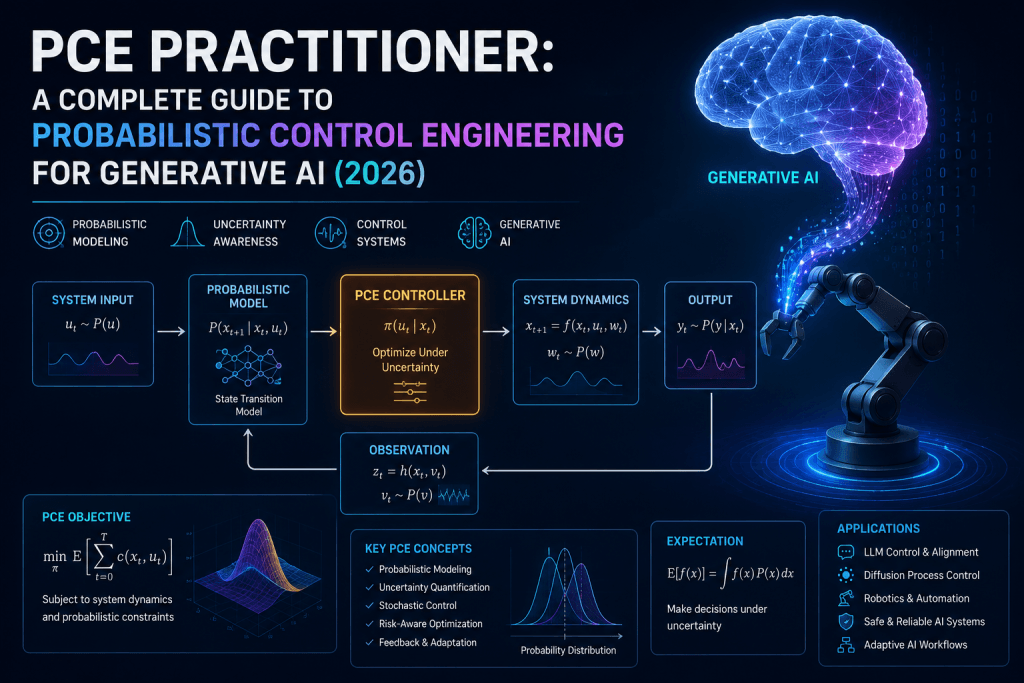
If you have been working in AI or engineering for a while, you have probably noticed that most real-world systems do not behave in perfectly predictable ways. Sensors fail. Data gets noisy. Models make unexpected decisions. This is exactly where Probabilistic Control Engineering steps in. This article is part of the Scientias AI Labs research hub on Probabilistic Control Engineering for Generative AI.
Probabilistic Control Engineering, or PCE, is a discipline that combines probability theory, control systems, and engineering principles to design, manage, and optimize systems that operate under uncertainty. Instead of assuming everything will go exactly as planned, PCE practitioners build systems that expect uncertainty and handle it gracefully.
Think of it this way. Traditional control engineering assumes you know exactly what the system will do at every step. PCE says — what if you don’t? What if your inputs are noisy, your model is imperfect, and your environment keeps changing? PCE gives you the mathematical tools and engineering frameworks to still make reliable decisions in that messy, uncertain world.
In the context of Generative AI, this becomes incredibly important. Large language models, diffusion models, and reinforcement learning systems are all inherently probabilistic. They don’t give you one fixed answer — they generate distributions of possible outputs. Managing, controlling, and optimizing these systems is exactly what a PCE practitioner does.
Why PCE Matters for Generative AI Systems
Generative AI has exploded in the last few years. From text generation to image synthesis to autonomous decision making, AI systems are now being deployed in healthcare, finance, robotics, and dozens of other critical domains.
But here is the problem that most people don’t talk about enough. These systems are unpredictable by nature. A language model doesn’t always give the same answer. A diffusion model generates slightly different images every time. A reinforcement learning agent explores and sometimes makes decisions that seem random.
This unpredictability is not a bug — it is actually a feature of how these systems work. But when you are deploying Generative AI in high-stakes environments, you need to understand, measure, and control that unpredictability. You need to know how confident the model is in its output. You need to set boundaries on what the model can and cannot do. You need to detect when the model is operating outside its reliable zone.
That is the job of a PCE practitioner. They bring rigorous probabilistic thinking to AI systems that would otherwise be black boxes and make them trustworthy, controllable, and deployable in the real world.
Core Principles of PCE
Probability Theory Foundations
At the heart of PCE is probability theory. A PCE practitioner works comfortably with probability distributions, conditional probabilities, joint distributions, and marginal probabilities. These are not just academic concepts — they are the tools used to describe how AI systems behave.
When a language model generates text, it is sampling from a probability distribution over possible tokens. Understanding that distribution — its shape, its variance, its tails — is fundamental to controlling the model’s behavior.
Uncertainty Quantification
One of the most important skills a PCE practitioner develops is the ability to quantify uncertainty. There are two main types of uncertainty that matter in Generative AI systems.
Aleatoric uncertainty is the natural randomness in the data itself. No matter how good your model is, some things are just inherently unpredictable. Epistemic uncertainty, on the other hand, comes from gaps in the model’s knowledge. This type of uncertainty can be reduced by giving the model more data or better training.
A skilled PCE practitioner knows how to separate these two types of uncertainty and respond appropriately to each.
Stochastic Control Systems
Stochastic control is about making optimal decisions when the system you are controlling has random elements. In Generative AI, this shows up constantly. How do you fine-tune a model whose outputs are stochastic? How do you set up a feedback loop when the signal you are measuring is noisy?
PCE practitioners use stochastic control theory to design systems that remain stable and reliable even when things don’t go exactly as expected.
Bayesian Decision Making
Bayesian reasoning is central to PCE. Instead of making decisions based on fixed rules, a PCE practitioner uses Bayesian inference to update beliefs based on new evidence. In Generative AI, this translates to building systems that get smarter and more reliable as they encounter more data.
Who is a PCE Practitioner?
Roles and Responsibilities
A PCE practitioner is someone who applies probabilistic control engineering principles specifically to AI and Generative AI systems. Their day-to-day responsibilities typically include designing uncertainty-aware AI pipelines, implementing probabilistic models that quantify confidence in AI outputs, building monitoring systems that detect when AI models behave unexpectedly, developing control mechanisms that constrain AI behavior within acceptable probability bounds, and collaborating with ML engineers, data scientists, and product teams to make AI systems production-ready.
Required Skills and Background
Becoming a competent PCE practitioner requires a mix of mathematical, engineering, and programming skills. On the mathematical side, you need a solid understanding of probability theory, statistics, linear algebra, and stochastic processes. On the engineering side, familiarity with control systems, feedback loops, and system stability is essential. On the programming side, Python is the dominant language, with specialized libraries for probabilistic programming playing a central role.
Industry Demand in 2026
The demand for PCE practitioners has grown significantly alongside the explosion of Generative AI deployments. Companies building AI products for healthcare, autonomous vehicles, financial services, and legal tech are actively looking for engineers who can bring probabilistic thinking to their AI systems. It is one of the most specialized and well-compensated roles in the AI engineering space right now.
PCE vs Traditional Control Engineering
Traditional control engineering deals with deterministic systems. You know your inputs, you know your system dynamics, and you can predict your outputs with reasonable precision. Classical tools like PID controllers work beautifully in this world.
Generative AI breaks all of those assumptions. The inputs are natural language or images — inherently high-dimensional and ambiguous. The system dynamics are learned from data and not fully understood. The outputs are distributions, not fixed values.
PCE extends classical control engineering into this probabilistic world. It keeps the rigorous engineering mindset — stability, reliability, performance guarantees — but replaces deterministic assumptions with probabilistic ones. A PCE practitioner is essentially a control engineer who has learned to think in distributions rather than fixed values.
PCE Frameworks Used in Generative AI
Markov Decision Processes
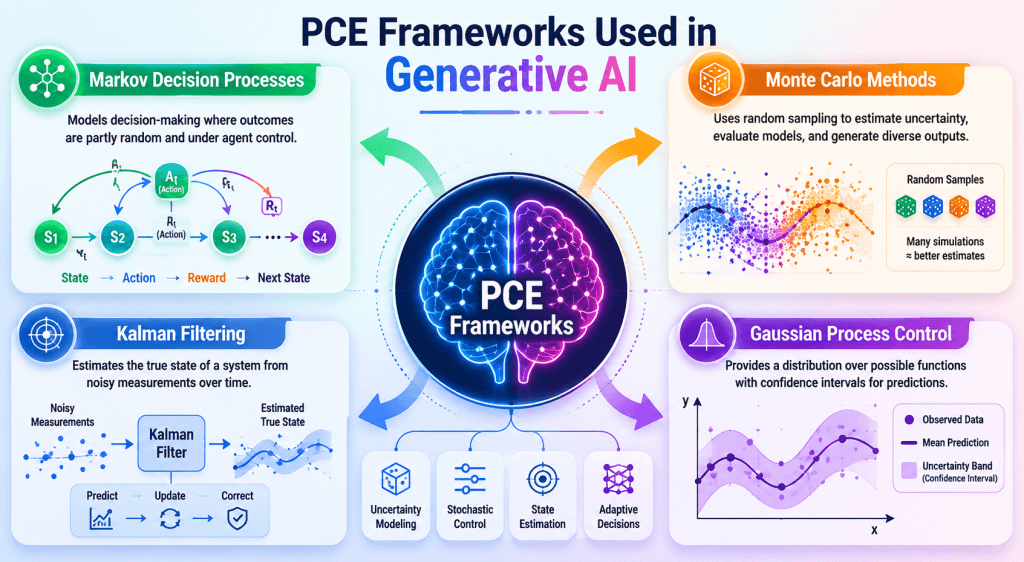
Markov Decision Processes, or MDPs, are the mathematical framework behind reinforcement learning. They model decision-making in environments where outcomes are partly random and partly under the control of the agent. PCE practitioners use MDPs to design and analyze AI systems that learn through interaction with their environment.
Monte Carlo Methods
Monte Carlo methods use random sampling to solve problems that might be deterministic in principle but are too complex to solve analytically. In Generative AI, Monte Carlo methods are used for uncertainty estimation, model evaluation, and generating diverse outputs. A PCE practitioner uses Monte Carlo simulation to understand how a model behaves across a wide range of possible inputs.
Kalman Filtering
Kalman filtering is a classic technique for estimating the state of a system when measurements are noisy. In Generative AI applications like autonomous systems and time-series prediction, Kalman filters help maintain reliable state estimates despite uncertain sensor readings.
Gaussian Process Control
Gaussian Processes provide a probabilistic approach to function approximation. Instead of fitting a single curve to data, Gaussian Processes fit a distribution over possible curves. This gives you not just a prediction but a confidence interval around every prediction — exactly the kind of uncertainty information a PCE practitioner needs.
How PCE Applies to Large Language Models
Large Language Models generate text by sampling from probability distributions over tokens. A PCE practitioner working with LLMs focuses on several key challenges.
Temperature control is one of the most direct applications. The temperature parameter in language model sampling directly controls the entropy of the output distribution. A higher temperature means more random, creative outputs. A lower temperature means more focused, deterministic outputs. Understanding this from a probabilistic control perspective — rather than just treating it as a dial to turn — allows PCE practitioners to set temperature dynamically based on the task requirements.
Confidence calibration is another critical area. A well-calibrated language model should express uncertainty when it is uncertain. PCE practitioners build calibration systems that measure whether a model’s stated confidence matches its actual accuracy, and correct it when it doesn’t.
PCE in Diffusion Models
Diffusion models have become the dominant architecture for image generation, audio synthesis, and increasingly for video and 3D content. They work by learning to reverse a gradual noising process — starting from pure noise and iteratively denoising until a coherent output emerges.
From a PCE perspective, diffusion models are stochastic control problems. The denoising process is a sequence of decisions made under uncertainty. PCE practitioners analyze the stability of this process, optimize the noise schedules, and design guidance mechanisms that steer the generation toward desired outputs while maintaining the probabilistic diversity that makes diffusion models powerful.
PCE in Reinforcement Learning from Human Feedback
Reinforcement Learning from Human Feedback, or RLHF, is the technique behind the fine-tuning of most modern language models. It involves training a reward model based on human preferences and then using that reward model to guide the language model’s behavior.
This is a deeply probabilistic process. Human preferences are noisy and inconsistent. The reward model is uncertain. The language model’s policy is stochastic. A PCE practitioner brings structure to this process by quantifying uncertainty at each stage, designing robust reward models that account for noisy human feedback, and building control mechanisms that prevent the language model from exploiting reward model weaknesses.
Tools and Libraries for PCE Practitioners
Python Libraries
Python is the primary language for PCE work in Generative AI. The core scientific computing stack — NumPy, SciPy, and Pandas — provides the foundation. Matplotlib and Seaborn are used for visualizing probability distributions and uncertainty estimates.
Probabilistic Programming Frameworks
Probabilistic programming frameworks are the specialized tools that set PCE practitioners apart. PyMC is one of the most popular choices, providing a flexible and intuitive interface for building Bayesian models. Stan is widely used in academic and research settings for its rigorous statistical foundations. NumPyro, built on JAX, offers high-performance probabilistic programming with GPU acceleration — particularly useful when working with large Generative AI models.
Real World Applications of PCE in Generative AI
Healthcare AI
In healthcare, AI systems assist with diagnosis, treatment planning, and drug discovery. The stakes are incredibly high. A PCE practitioner working in healthcare AI builds systems that not only make predictions but accurately quantify how confident those predictions are — flagging cases where the model is uncertain and human review is needed.
Autonomous Systems
Self-driving vehicles and robotic systems operate in environments full of uncertainty. Sensor noise, unexpected obstacles, and unpredictable human behavior all create challenges that deterministic systems cannot handle. PCE practitioners design the probabilistic perception and decision-making systems that allow autonomous agents to navigate these environments safely.
Financial Modeling
Financial markets are inherently stochastic. Generative AI is increasingly being used for risk modeling, portfolio optimization, and market simulation. PCE practitioners bring rigorous uncertainty quantification to these applications, ensuring that AI-generated financial models include proper confidence intervals and risk estimates.
Content Generation
Even in creative applications like content generation, PCE has a role. Controlling the diversity, consistency, and quality of AI-generated content requires understanding the probabilistic nature of generative models and designing systems that reliably produce outputs within desired parameters.
Challenges PCE Practitioners Face
Working at the intersection of probability theory and Generative AI is not without its difficulties. One of the biggest challenges is computational cost. Properly quantifying uncertainty in large neural networks is expensive — methods like Monte Carlo Dropout or deep ensembles require running the model multiple times for every prediction.
Another challenge is communicating uncertainty to non-technical stakeholders. Telling a product manager that your model is 73% confident is meaningless without context. PCE practitioners need to translate probabilistic concepts into business language that drives good decision-making.
Finally, there is the challenge of distribution shift. A model trained on one distribution of data may encounter very different data in production. PCE practitioners build monitoring systems that detect when this happens and trigger appropriate responses.
Future of PCE in Generative AI
The future of PCE in Generative AI looks remarkably promising. As AI systems become more deeply embedded in critical infrastructure, healthcare, and autonomous systems, the need for rigorous probabilistic control will only grow.
We are likely to see PCE principles become standard practice in AI engineering teams, much the way unit testing and code review are standard in software engineering. Specialized PCE tools and frameworks built specifically for Generative AI will emerge. And the role of PCE practitioner will become a recognized and sought-after specialization within the broader AI engineering field.
How to Become a PCE Practitioner — Roadmap
If you are interested in becoming a PCE practitioner, here is a practical path forward. Start by building strong foundations in probability theory and statistics — there is no shortcut here. Work through a rigorous statistics textbook and complement it with online courses in Bayesian inference.
Next, develop your programming skills in Python with a focus on probabilistic programming libraries. Build small projects using PyMC or NumPyro to get hands-on experience with Bayesian modeling.
Then move into Generative AI fundamentals. Understand how language models, diffusion models, and reinforcement learning systems work at a mathematical level — not just how to use them as tools.
Finally, combine these skills by working on projects that sit at the intersection. Build a calibration system for a language model. Implement uncertainty quantification for a diffusion model. Contribute to open source probabilistic AI projects.
The path is challenging but the combination of skills is rare enough that those who develop it will find themselves in very high demand.
Conclusion
Probabilistic Control Engineering is not a niche academic exercise — it is becoming one of the most practically important disciplines in AI engineering. As Generative AI systems move from research labs into production environments where reliability and trust are non-negotiable, the PCE practitioner becomes an essential member of any serious AI team.
If you are an engineer or researcher looking to differentiate yourself in the AI space, developing PCE skills puts you at the intersection of two powerful trends — the maturation of Generative AI and the growing demand for trustworthy, controllable AI systems. That is a very good place to be in 2026 and beyond.
What does PCE stand for in AI?
PCE stands for Probabilistic Control Engineering — a discipline that applies probability theory and control systems to manage uncertainty in AI and Generative AI systems.
Is PCE a certified profession?
Currently there is no single globally recognized PCE certification. However, professionals typically combine certifications in Bayesian statistics, control systems engineering, and machine learning to build credibility in this space.
What programming language do PCE practitioners use?
Python is the dominant language. Key libraries include PyMC, NumPyro, Stan, NumPy, and SciPy for probabilistic modeling and uncertainty quantification.
How is PCE different from traditional machine learning?
Traditional machine learning focuses on building predictive models. PCE focuses on understanding, quantifying, and controlling the uncertainty within those models — especially in production environments.
Do I need a PhD to become a PCE practitioner?
No. While a strong mathematical background is essential, many successful PCE practitioners come from engineering or computer science degrees. Practical experience with probabilistic programming and Generative AI matters more than academic credentials.
What industries hire PCE practitioners?
Healthcare AI, autonomous vehicles, financial services, robotics, defense, and any industry deploying Generative AI in high-stakes environments actively look for PCE skills.
How long does it take to become a PCE practitioner?
With a solid engineering or mathematics background, most people develop practical PCE skills within 12 to 18 months of focused study and project work.
Is PCE relevant for Large Language Models?
Absolutely. Temperature control, confidence calibration, hallucination detection, and output distribution management in LLMs are all directly PCE applications.
What is the salary of a PCE practitioner in 2026?
Given the specialization, PCE practitioners command premium salaries. In the US, expect $150,000 to $220,000 annually. In India, senior PCE roles typically range from ₹25 to ₹50 lakhs per year.
Where can I learn PCE for Generative AI?
Start with Bayesian statistics courses on Coursera or edX, then move to probabilistic programming with PyMC documentation, and complement with Generative AI fundamentals from fast.ai or Hugging Face courses.