
Table of Contents
For a long time, prompt engineering was considered the secret skill behind getting better results from AI systems.
People experimented with:
- clever wording
- structured prompts
- role-playing instructions
- formatting tricks
- chain-of-thought prompts
And honestly, it worked.
A well-written prompt could dramatically improve AI outputs.
But modern AI systems are evolving fast.
Today’s advanced AI tools don’t just rely on prompts anymore.
They rely on something much bigger:
context engineering
And that shift is changing how developers build AI systems, coding agents, and autonomous workflows.
What Is Prompt Engineering?
Prompt engineering is the process of designing inputs that guide an AI model toward better outputs.
In simple terms:
You carefully tell the AI what you want.Examples include:
- assigning roles
- providing examples
- specifying output formats
- breaking tasks into steps
- adding constraints
For example:
You are a senior Python developer. Explain recursion using simple examples.That’s prompt engineering.
The focus is mainly on:
- wording
- instruction quality
- formatting
- clarity
And for early AI systems, prompts were incredibly important.
Why Prompt Engineering Became Popular
Early large language models had:
- smaller context windows
- weaker reasoning
- limited memory
- minimal tool access
So the only real way to improve outputs was by carefully crafting prompts.
This created an entire culture around:
- prompt templates
- jailbreaks
- prompt hacks
- system prompts
- “magic prompts”
At one point, prompt engineering almost felt like a superpower.
But Modern AI Systems Changed the Game
Today’s AI systems are far more sophisticated.
Modern tools like:
- Claude Code
- ChatGPT Codex
- Cursor AI
- OpenAI Agents
- Anthropic MCP workflows
don’t rely only on prompts.
Modern AI coding assistants like Claude Code and ChatGPT Codex increasingly depend on advanced context engineering techniques to understand repositories, maintain workflow memory, and interact intelligently with development environments.
Instead, they operate using:
- repository context
- tool outputs
- conversation history
- memory systems
- retrieved documents
- APIs
- execution environments
- structured workflows
That’s where context engineering enters the picture.
What Is Context Engineering?
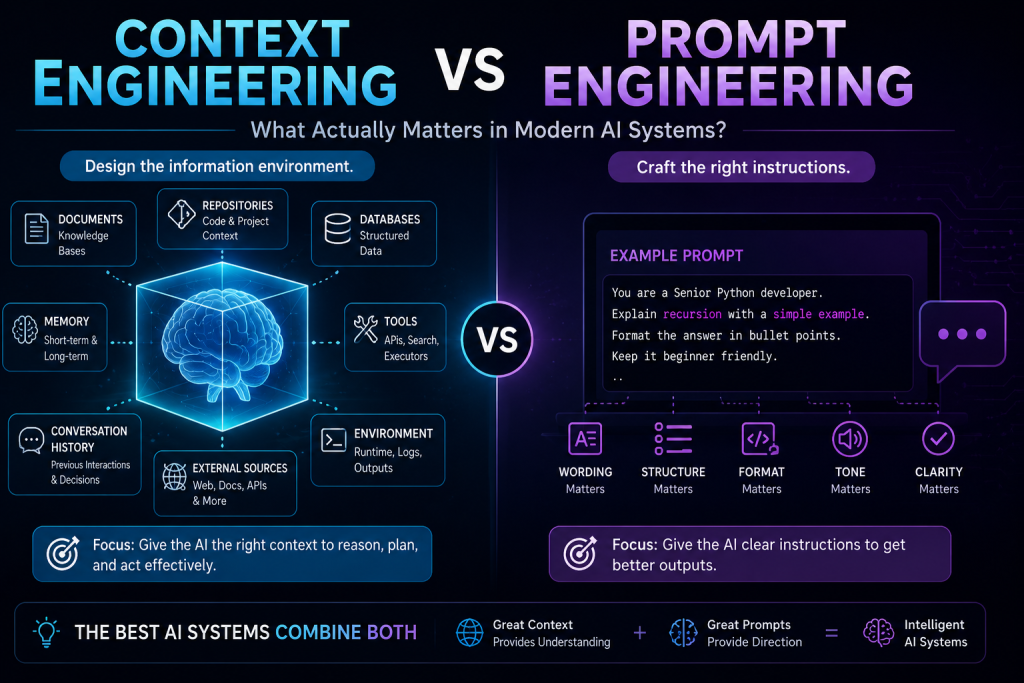
Context engineering is the process of designing the information environment surrounding an AI model.
Instead of focusing only on:
“How should I phrase the prompt?”context engineering asks:
“What information should the AI have access to?”That’s a massive difference.
Modern AI Systems Run on Context
Today’s advanced AI agents succeed because they can access:
- documentation
- repositories
- databases
- memory
- tools
- APIs
- external knowledge
- prior conversations
The prompt is now only one small part of the system.
The real power comes from:
the quality of the context.Repository-aware AI systems are also changing how developers structure project instructions and workflow context. Our CLAUDE.md vs AGENTS.md article explains how modern AI coding assistants use repository-level context to improve reasoning, automation, and developer productivity.
A Simple Example
Imagine asking an AI coding assistant:
Fix this authentication bug.A prompt-only system might struggle.
But a context-engineered system can:
- read the repository
- inspect authentication middleware
- analyze logs
- understand dependencies
- check environment variables
- execute tests
- inspect previous commits
Now the AI operates with actual understanding.
That’s context engineering in action.
Prompt Engineering vs Context Engineering
Prompt Engineering Focuses On:
- wording
- instructions
- formatting
- role assignment
- prompt structure
Context Engineering Focuses On:
- memory
- retrieval
- repositories
- tools
- external systems
- structured information flow
- long-term context
- environment design
Why Context Engineering Matters More in 2026
As AI systems become more agentic, context becomes more important than prompts.
Because intelligent agents need:
- situational awareness
- memory
- tool access
- repository understanding
- execution history
- workflow state
A beautifully written prompt means very little if the AI lacks the right context.
Meanwhile, a strong context system can often compensate for weaker prompts.
That’s a huge shift happening right now in AI engineering.
This Is Why RAG Became Important
Retrieval-Augmented Generation (RAG) is fundamentally a context engineering technique.
RAG improves AI systems by retrieving:
- documents
- knowledge
- embeddings
- database content
- external information
before generation happens.
In other words:
RAG improves context instead of only improving prompts.That’s why modern AI systems increasingly rely on:
- vector databases
- embeddings
- retrieval pipelines
- memory systems
instead of prompt tricks alone.
Modern context engineering systems heavily rely on retrieval pipelines, memory architectures, and tool integration workflows. Our detailed RAG vs TAG guide explores how modern AI agents combine retrieval-based reasoning with tool-augmented execution in real-world AI systems.
AI Agents Depend on Context Engineering
Modern AI agents are essentially context-driven systems.
An autonomous coding agent might need:
- repository access
- task memory
- API connections
- tool execution
- terminal outputs
- planning history
Without that context, the agent becomes unreliable very quickly.
This is also why technologies like:
- MCP
- tool calling
- repository indexing
- memory systems
are becoming foundational in AI engineering.
Prompt Engineering Is Still Important
This doesn’t mean prompts are useless.
Good prompts still matter.
Clear instructions help AI systems:
- reduce ambiguity
- follow structure
- improve formatting
- maintain consistency
But prompts are increasingly becoming:
one layer of a much larger AI architecture.That’s the important distinction.
The Best AI Systems Combine Both
The strongest modern AI workflows combine:
- strong prompting
AND - strong context systems
For example:
- clear instructions
- repository awareness
- retrieved documentation
- execution tools
- memory
- structured workflows
all working together.
This is how advanced AI coding agents now operate.
Why Developers Should Learn Context Engineering
Many developers still focus only on:
- prompt tricks
- fancy templates
- viral prompt techniques
But the industry is rapidly shifting toward:
- AI orchestration
- context pipelines
- retrieval systems
- memory architectures
- tool integration
Understanding context engineering is becoming a major advantage for:
- AI engineers
- agent developers
- automation architects
- LLM application builders
The Future of AI Engineering
The future likely belongs to systems that:
- remember better
- retrieve smarter
- understand environments
- use tools effectively
- maintain workflow context
Not just systems with clever prompts.
That’s why modern AI engineering is increasingly focused on:
context-aware intelligence.And honestly, this shift is only getting started.
Final Thoughts
Prompt engineering helped introduce people to the power of AI interaction.
But context engineering is shaping the next generation of intelligent systems.
Modern AI is no longer just about asking better questions.
It’s about building better environments for AI reasoning.
The future of AI systems will depend less on:
- perfect prompts
and more on:
- memory
- retrieval
- tools
- workflows
- repositories
- context orchestration
Because ultimately:
AI performs best when it understands the environment it operates in.And that understanding comes from context.
What is prompt engineering?
Prompt engineering is the process of designing prompts and instructions that guide AI systems toward better outputs.
What is context engineering?
Context engineering focuses on designing the information environment around AI systems, including memory, retrieval, repositories, tools, and workflow context.
Is context engineering replacing prompt engineering?
Not entirely. Prompt engineering still matters, but modern AI systems increasingly rely more on high-quality context than prompt wording alone.
Why is context important for AI agents?
AI agents need memory, tools, repository awareness, and workflow state to operate effectively. Without context, autonomous systems become unreliable.
What technologies are related to context engineering?
Technologies like RAG, vector databases, MCP, embeddings, tool calling, and memory systems are all important parts of modern context engineering.